
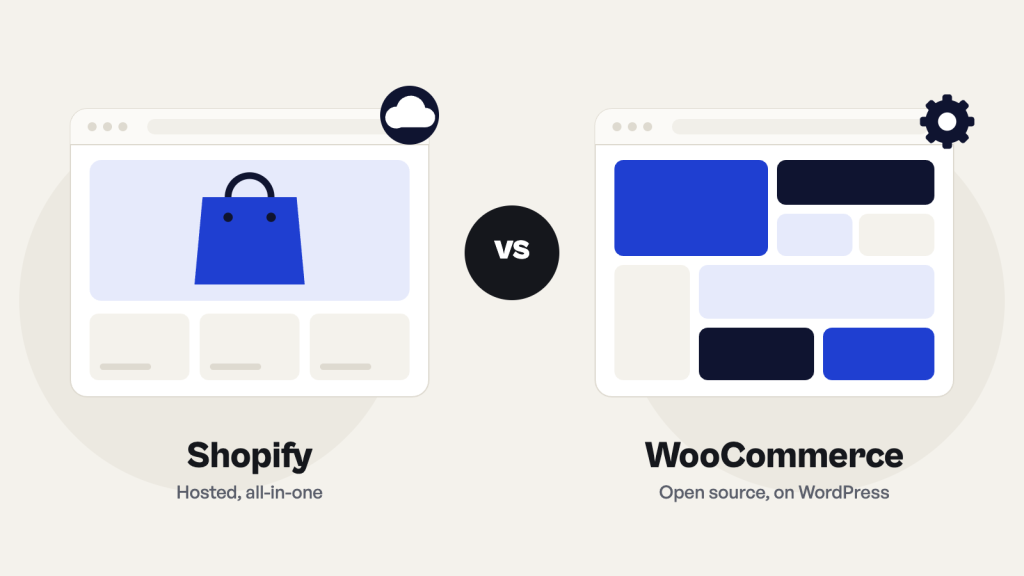
If you are planning an online store, one of the first decisions you will make is which platform to build it on. Shopify and WooCommerce are the two most popular choices, and both run successful stores of every size. But they work in very different ways, and the right one depends on your budget, your plans and how hands-on you want to be. We build stores on both, so here is an honest comparison.
The core difference: renting vs owning
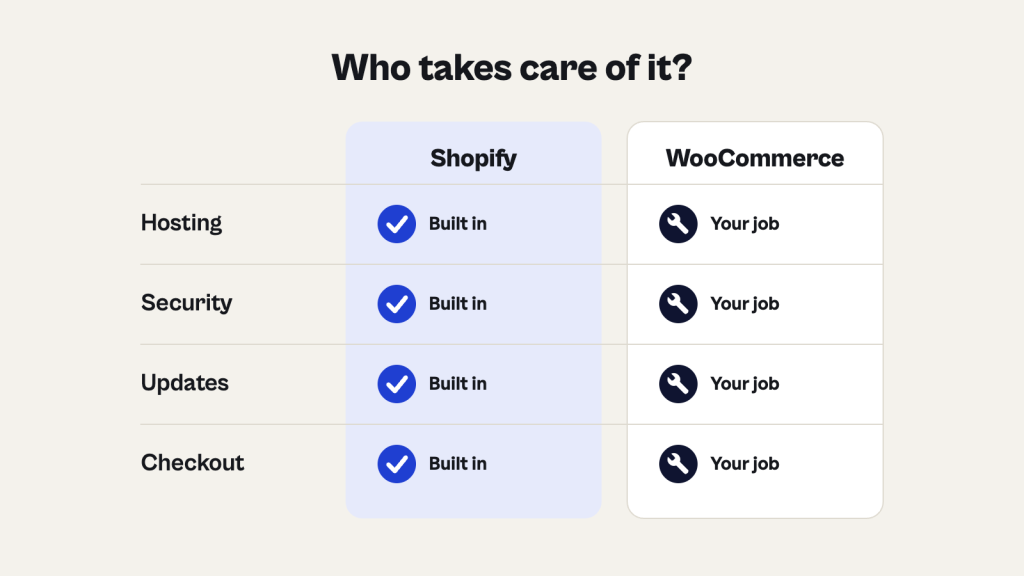
Shopify is a hosted, all-in-one service. You pay a monthly subscription, and Shopify takes care of the hosting, security, software updates and checkout. You log in, add your products and start selling.
WooCommerce is a free plugin that turns a WordPress website into a store. It runs on your own hosting, which gives you full control over your site and your data, along with the responsibility of keeping it running.
A simple way to picture it: Shopify is like renting a fully serviced shop in a mall, while WooCommerce is like owning your own building.
What does each one cost?
Shopify’s main plans cost $39, $105 and $399 a month when billed monthly, or $29, $79 and $299 a month when you pay yearly. If you use Shopify Payments there is no extra platform fee on your sales, but if you choose another payment provider, Shopify adds a fee of 2% on Basic, 1% on Grow and 0.6% on Advanced. Many stores also pay for apps that add extra features.
WooCommerce itself is free, with no monthly subscription. Your costs come from hosting, which WooCommerce estimates at $25 to $350 a month for most stores, plus your domain, any premium extensions (typically $29 to $299 a year each) and your payment processor’s fees. There is no platform fee on your sales.
In short, Shopify’s costs are predictable, while WooCommerce can work out cheaper, especially as you grow, but depends more on the choices you make.
| Shopify | WooCommerce | |
|---|---|---|
| Setup | Quick and guided | Needs hosting and configuration |
| Monthly cost | From $29 to $39, plus apps | Hosting, plus optional extensions |
| Fees on sales | None with Shopify Payments, 0.6% to 2% otherwise | None from the platform |
| Customization | Themes and apps, within limits | Full access to code and data |
| Maintenance | Handled by Shopify | Your job, or your developer’s |
| Content and SEO | Good | Excellent, thanks to WordPress |
Ease of use
Shopify is the easier place to start. The dashboard is clean, the setup is guided, and you never have to think about servers or plugin updates. If you want to launch quickly and focus on selling, that matters.
WooCommerce has a steeper learning curve at the beginning. Once it is set up properly, though, day-to-day tasks like adding products and managing orders are straightforward, and anyone already familiar with WordPress will feel at home.
Flexibility and control
This is where WooCommerce shines. Because it is open source, you can change almost anything: the design, the checkout, the way products are organised and how your store connects with other tools. Your data lives on your own hosting, and you are never tied to one company’s rules or pricing.
Shopify is flexible too, through its themes and app store, but within limits. Deeper changes to the checkout, for example, are largely reserved for its enterprise plan, Shopify Plus. For most small and medium stores that is not a problem, but it is worth knowing.
Content and SEO
If content is part of your marketing, such as a blog, buying guides or landing pages, WooCommerce has a natural advantage because it runs on WordPress, the most widely used content platform on the web. Shopify includes a blog and solid SEO basics, but WordPress gives you more control over how your content is structured and presented.
Which one should you choose?
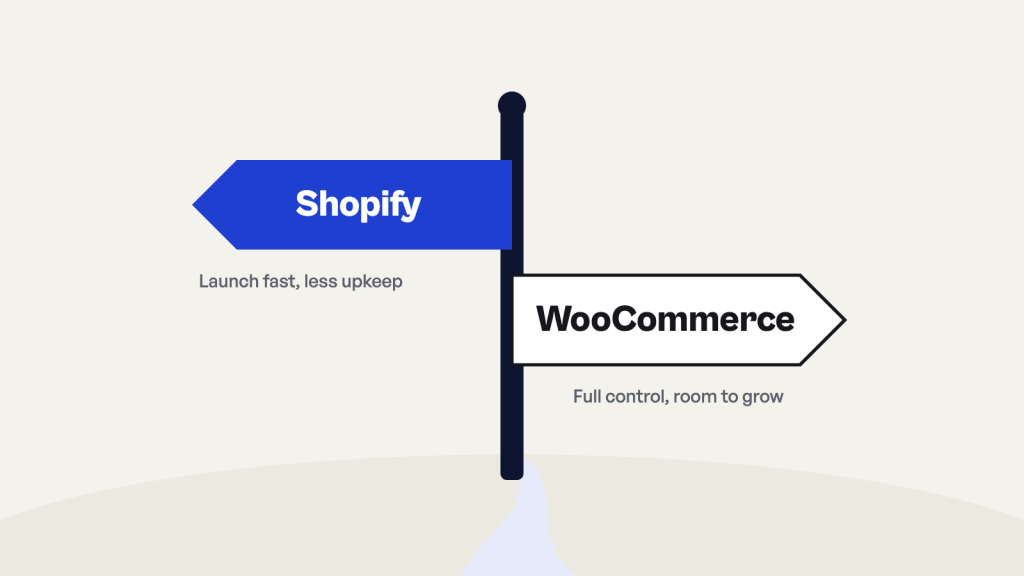
Choose Shopify if:
- You want to launch quickly with minimal setup
- You prefer one predictable monthly bill
- You do not want to manage hosting, updates or security
- You are happy working within Shopify’s themes and apps
Choose WooCommerce if:
- You already have a WordPress website or plan to publish a lot of content
- You want full control over your design, data and checkout
- You want to avoid platform fees on your sales
- You have a developer or a care plan to keep the site maintained
Our take
Neither platform is better in every case. For most first-time sellers who want to get online quickly, Shopify is the simpler choice. For businesses that value control, already use WordPress or rely on content to attract customers, WooCommerce is usually the better long-term investment. Our client Camping Pillow, for example, runs on WooCommerce.
Still not sure? Tell us about your products and plans, and we will recommend the platform that fits, even if that means a smaller project for us.
Prices are taken from Shopify and WooCommerce’s official pricing pages in October 2026 and may change.
